
Co-creating a mobile platform that turns everyday hygiene into immersive care—with adaptive AI insights and real-time AR feedback at its core.
AI-assisted self-checks improved awareness of early symptoms
Gamified and visualized progress improved consistency
All interfaces designed for readability, contrast, and screen reader compatibility
I co-led the UX/UI design of a next-gen dental care app alongside another designer. My focus was on conducting user research, translating insights into actionable design flows, and leading the integration of both AI-powered risk assessments and real-time AR guidance. From patient journeys to high-fidelity prototypes, I helped shape a seamless, inclusive experience tailored for both patients and providers.
~5 months (from concept to validated prototype)
When I joined this early-stage healthtech team, our goal wasn’t just to digitize checklists—it was to create a daily, visual health companion that helps users care before it hurts.
Most users didn’t think about oral health unless something went wrong—preventive care wasn’t part of their routine.
Dentists lacked visibility into patient behavior between appointments, making early intervention nearly impossible.
Our task wasn’t to digitize a checklist—it was to design a smart, engaging, and educational companion that felt both clinical and human, built on the company’s core strengths:
AI for personalized risk insights
AR for immersive oral health education & analysis
Mobile-first design for long-term preventive care
We combined qualitative and quantitative methods to understand user pain points, habits, and gaps in existing solutions.
“I never thought about my oral health until something really started hurting.”
“If I could see what was wrong or track things visually, I’d take it more seriously.”
“I only see patients a few times a year—by then, it’s often too late. If I had access to real-time hygiene data between visits, I could actually help them prevent problems, not just fix them.”
60+ responses
Analyzed dental apps, general wellness platforms, and AI health tools. Noted poor adoption due to over-complication and lack of emotional design.
Created primary personas representing both patients and dentists, reflecting their unique goals, pain points, and motivations. These helped keep the design grounded in real human needs throughout the product journey.


Our research revealed a disconnect between everyday dental habits and professional care—patients lacked real-time feedback, and dentists lacked insight between visits. This gap shaped every design decision.
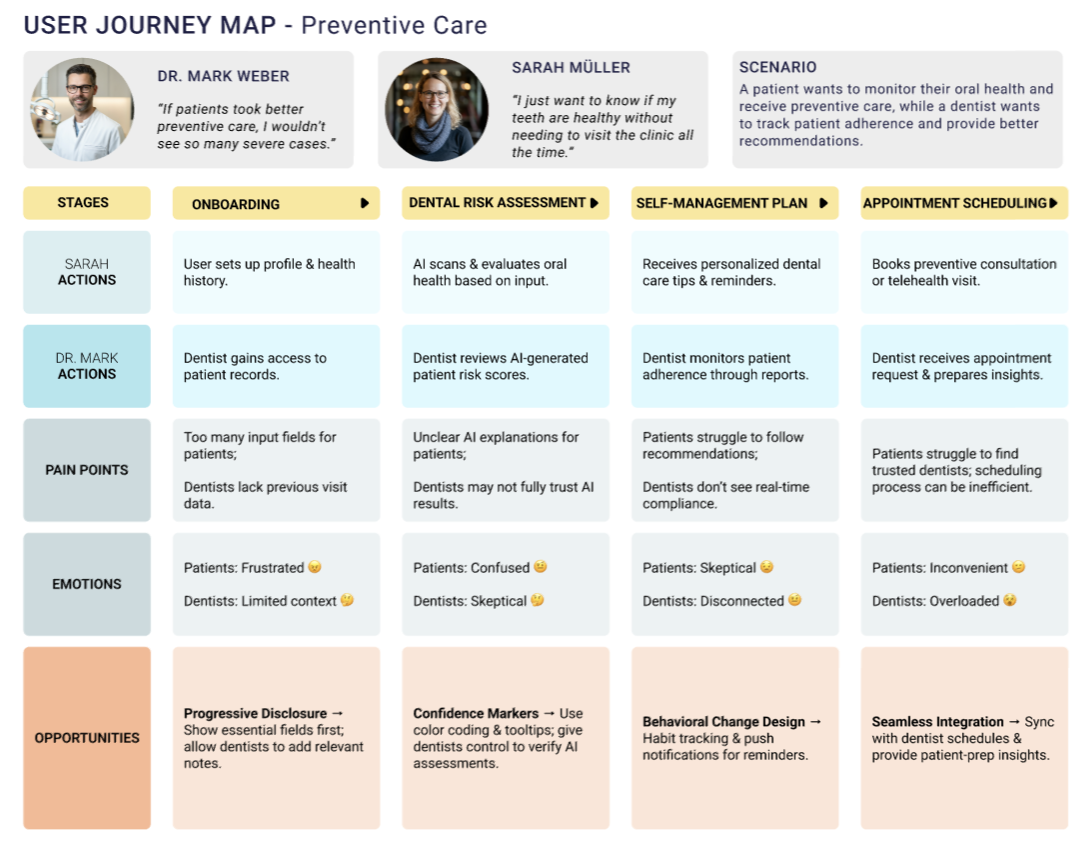
Mapped out current and ideal user journeys to identify friction points—especially around confusion with AI results and disconnection between checkups and daily care.
This guided the restructuring of flows across scanning, symptom checking, and care planning.
Together with another designer and our dev team, we shaped the product vision into a UX roadmap anchored in:
Use machine learning to generate risk scores from behavior, symptoms, and questionnaire inputs—but present it in simple, trustable language for everyday users.
Future-proof the UI structure for upcoming AR modules: 3D brushing guides, oral anatomy visualization, and habit feedback loops.
Design for both patients (self-care) and dentists (insight dashboards) with consistent visual language and behavior.
Incorporate behavior design to motivate daily hygiene, track streaks, and reduce friction for care plan adherence.
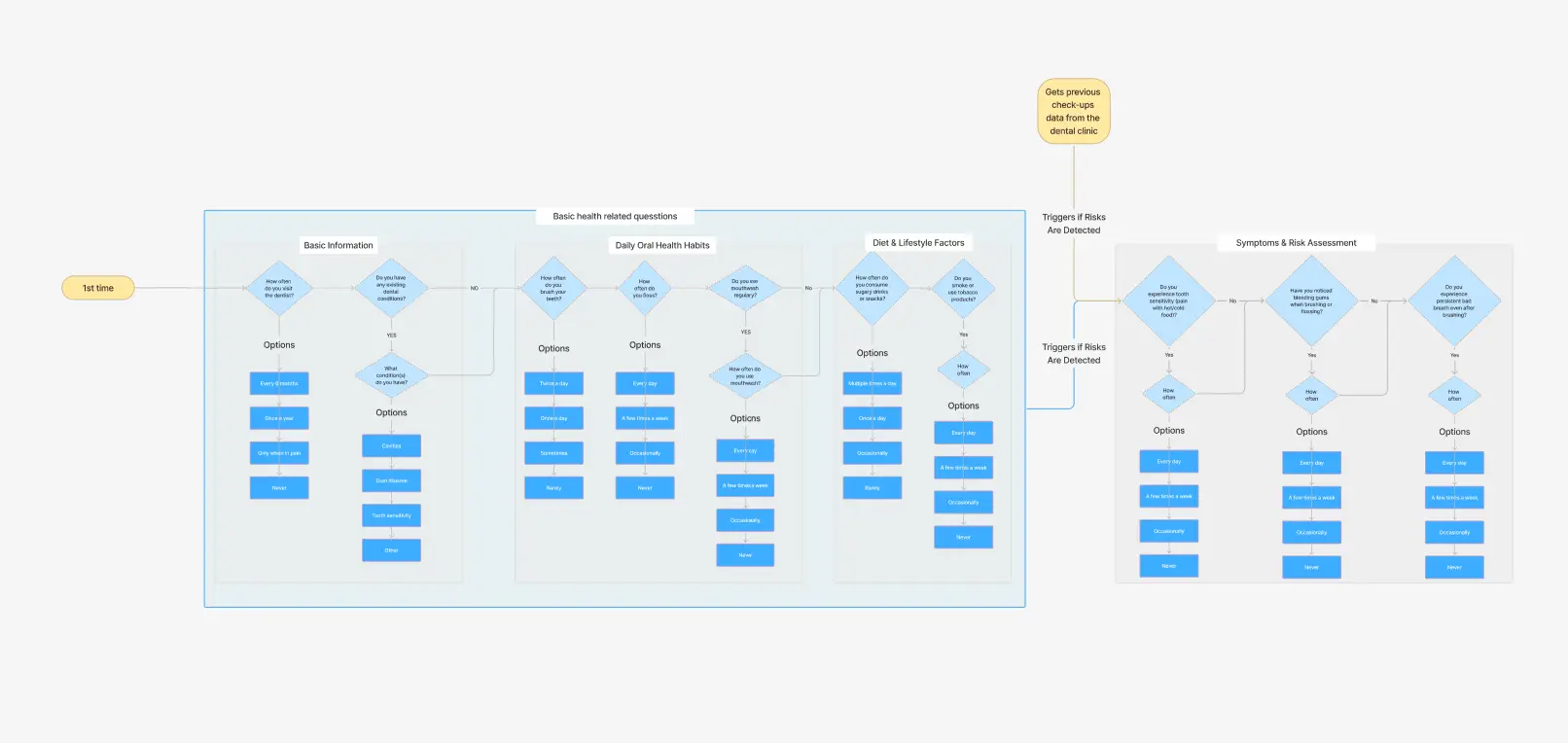
Refined the app’s IA to streamline access to essential tasks like scanning, care plan review, and dental booking. Grouped information intuitively and aligned it with mental models of both patients and professionals.
Based on stakeholders, here wee came up with the list of core features
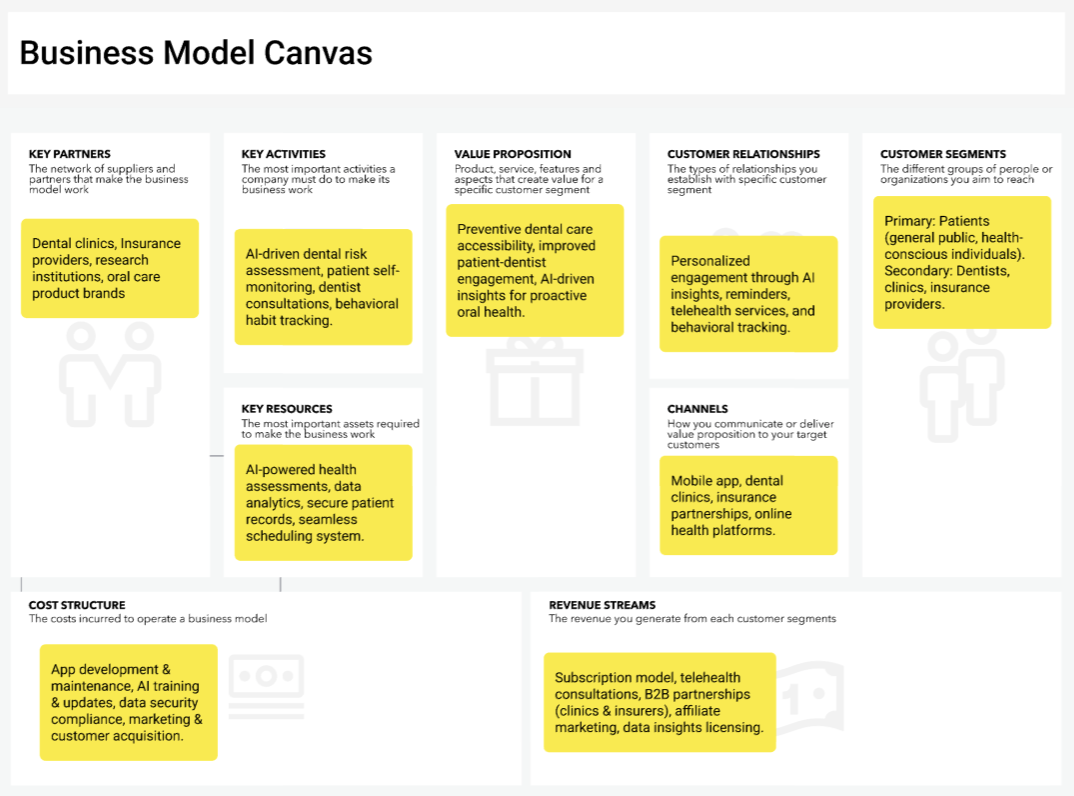
Created a business model canvas early in the design phase to align UX decisions with the company’s revenue and growth strategy.
This included potential monetization paths via subscription plans, dentist partnerships, and value-added telehealth features.
In designing this preventive dental care app, we prioritized healthcare-specific UX principles to ensure safety, trust, and clarity throughout the experience:
to validate the accuracy of all AI-driven insights before presenting them to users, preventing misinformation.
that translated complex clinical data into understandable, supportive language—reducing user anxiety and fostering engagement.
applying WCAG AA standards rigorously to AR overlays and UI components, and tested with diverse user groups to cover varying abilities and health literacy.
consciously avoiding fear-based messaging or manipulative patterns, and promoting user empowerment through transparency and choice.
within the AR and UI flows, revealing information step-by-step to avoid overwhelming users while still providing all necessary context.
by designing secure data flows and transparent consent processes in partnership with the product and legal teams.
consciously avoiding fear-based messaging or manipulative patterns, and promoting user empowerment through transparency and choice.
during AR interactions to ensure users felt informed—not judged—when viewing their dental condition, and adjusted UI tone and visuals accordingly to promote positive behavior change.
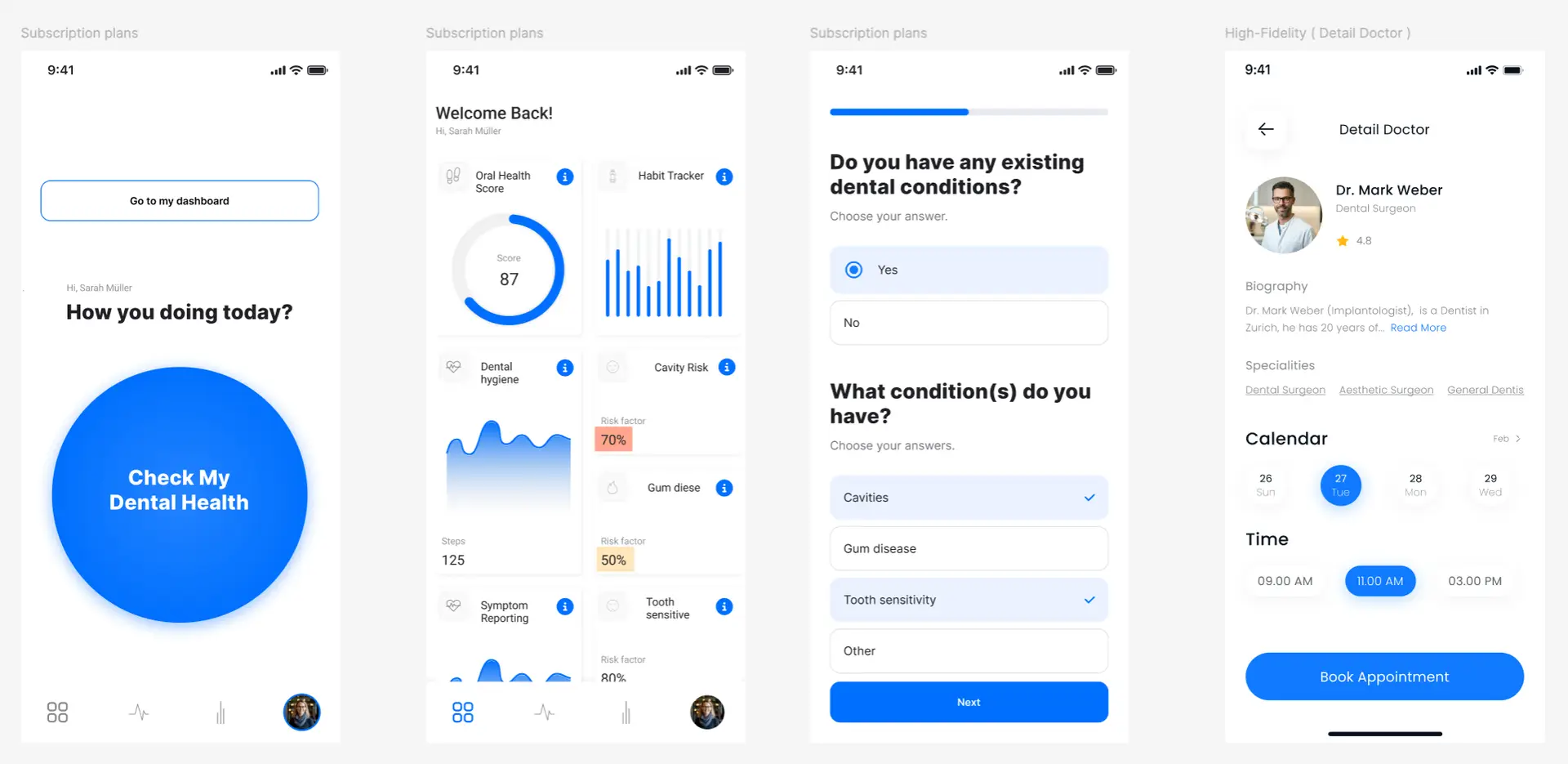
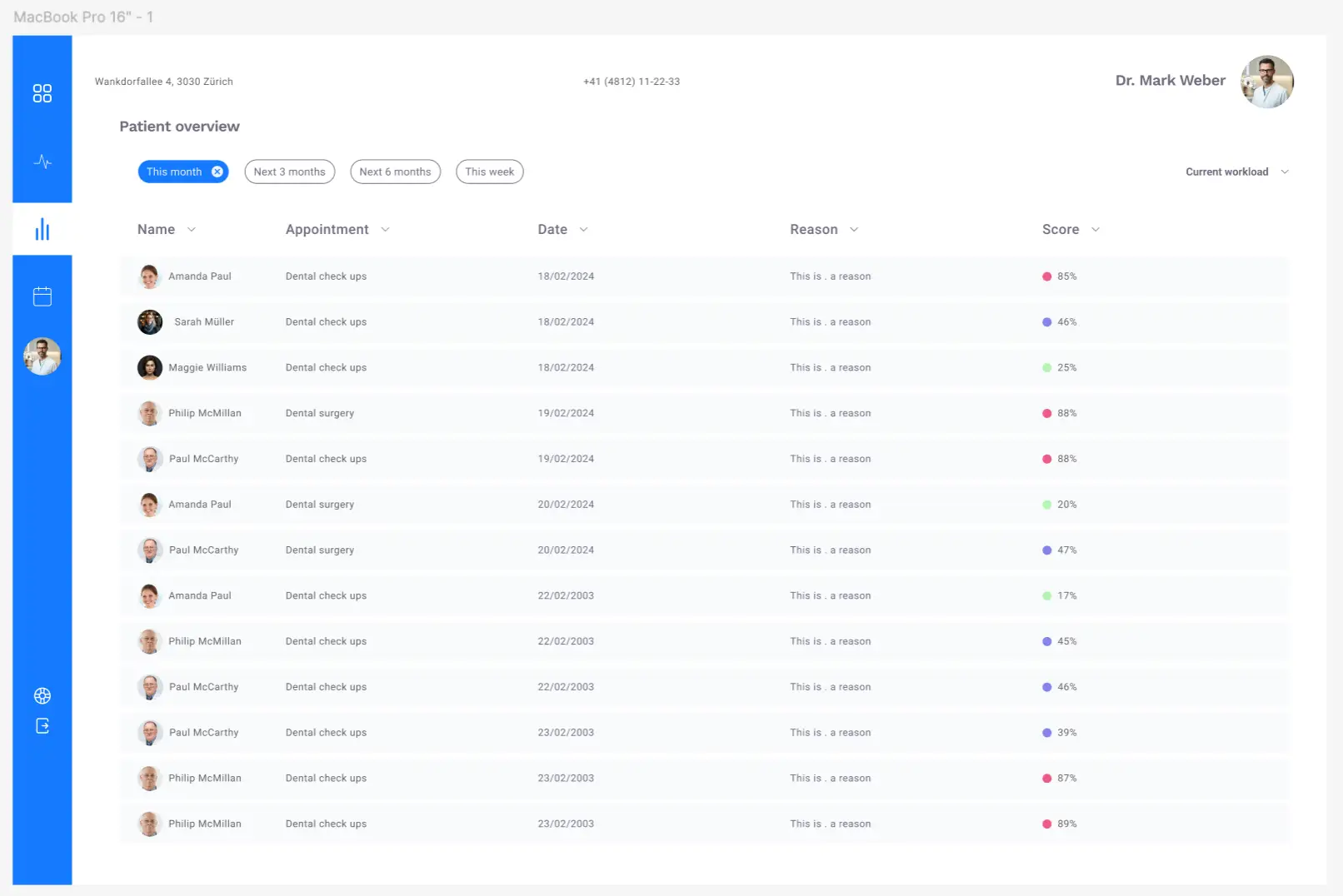
We translated our UX strategy into detailed wireframes and high-fidelity prototypes covering both patient-facing and dentist-facing journeys.
On the patient side, the flow includes:
An AI-powered self-check that guides users through an oral health scan
A personalized dashboard with visual risk scores, habit tracking, and progress insights
An adaptive questionnaire that adjusts based on user inputs to refine risk assessments
A calendar interface for seamless appointment scheduling, reminders, and telehealth access
On the provider side, the dentist portal includes:
A sortable patient table showing oral health scores, self-reported symptoms, and care adherence
Color-coded risk levels for triaging care plans
Quick actions for scheduling follow-ups or updating patient recommendations
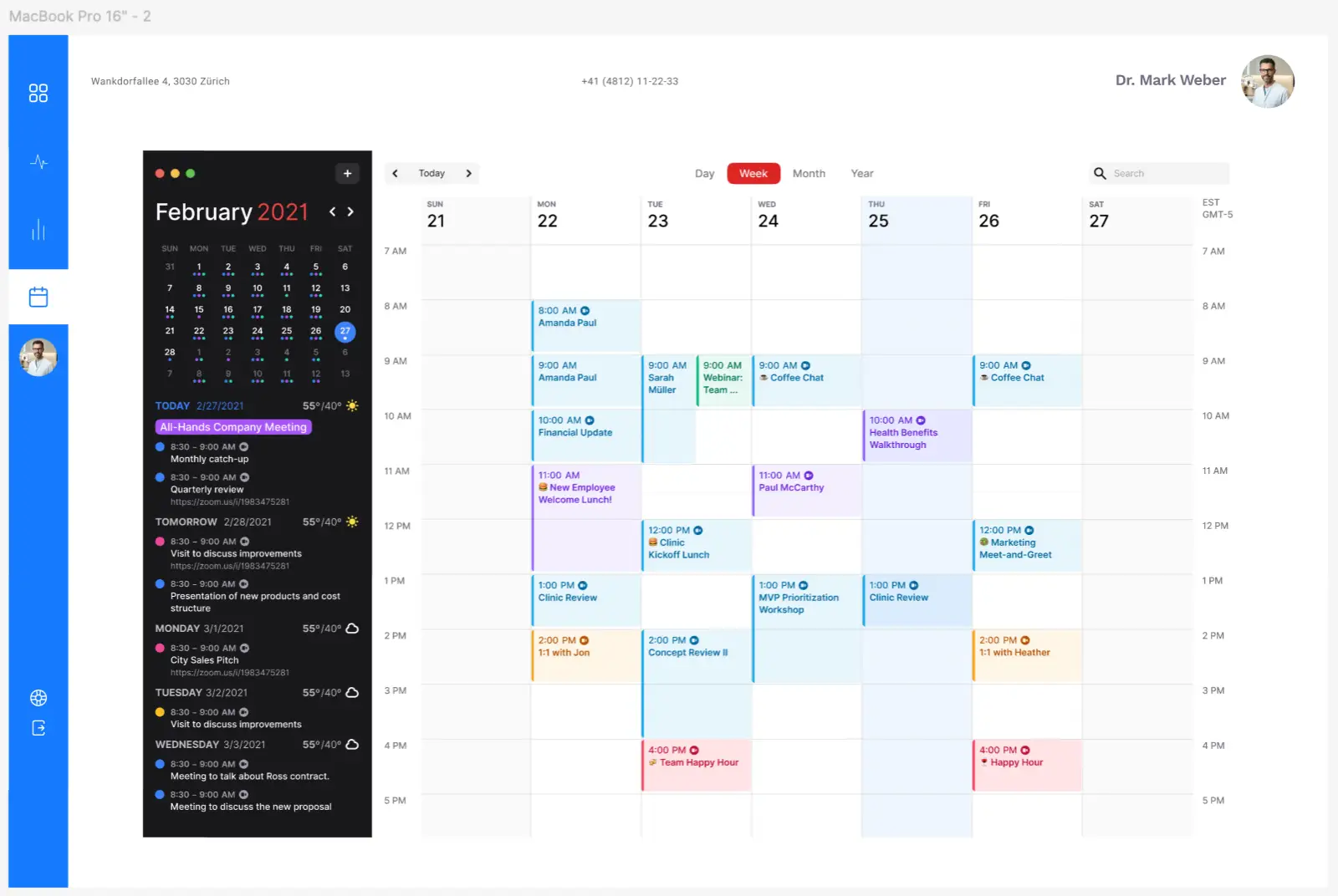
Key metrics after usability rounds
in completing an AR-guided scan
confidence in their oral hygiene
said the patient visual reports were “very helpful”
satisfaction on “ease of understanding results”
Designing for healthcare isn’t just about usability—it’s about building trust, encouraging behavior change, and aligning emerging tech with real human needs.
Seeing is Believing: Users take action when they see risks on themselves, not as abstract info
AR ≠ Gimmick: When paired with health logic and empathy, AR becomes a true behavioral driver
Design for Emotion: The tone of guidance—soft, encouraging—made users more engaged and less defensive
Cross-team Prototyping is Key: Early collaboration with devs and AI teams ensured feasibility, not fantasy
This wasn’t just about brushing or booking appointments. It was about giving users the power to understand and care for their own health—visually, interactively, and intelligently.
By embedding real-time AR and AI into the very heart of the user journey, we transformed the way people relate to dental care: not as a chore, but as a daily, empowered choice.
The future of healthcare UX isn’t passive. It’s adaptive, immersive, and human.
If your product is exploring AI, AR, or healthtech—and you’re looking for a UX designer who can bridge emotion, behavior, and emerging tech—let’s connect.